Every April, the IRS Quietly Waits
for You to Forget the 74,000 Pages
of Deductions They Wrote Into the Tax Code
Specifically for People Like You.
Most taxpayers forget. The ones who don't are called wealthy. This is how they got there.
Instant download. 30-day money-back guarantee.
Sandra is a registered nurse. Her husband Kevin manages their two rental properties full-time. Between them, they earn $134,000 a year.
For the first four years they owned their rentals, they used the same accountant they'd used since they got married. He was competent, friendly, and charged $600 to file their return. He caught all the obvious deductions. He never missed a deadline.
He also never told them about the depreciation recapture strategy. He never mentioned Real Estate Professional status. He never ran the numbers on a cost segregation study or explained what the Qualified Business Income deduction was.
He wasn't incompetent. He just wasn't specialized. And in the world of real estate taxes, generalist advice is expensive silence.
In 2022, Sandra and Kevin switched to a real estate CPA. In their first year working together, the CPA implemented five strategies from the playbook you're about to read.
Their federal tax bill dropped from $22,400 to $12,222.
That's $10,178 they kept. $10,178 they reinvested. $10,178 that is now compounding in their portfolio instead of disappearing into the government.
Same income. Same properties. Same year. Different knowledge.
"The tax code is 74,000 pages long. It was not written to make things harder for real estate investors. It was written to reward them. Most people never learn to read it."
THE PROBLEM
Here is the uncomfortable truth that nobody in the tax industry profits from telling you:
American taxpayers collectively overpay the federal government by an estimated $1.6 trillion every year. Not through fraud. Not through error. Through ignorance — a failure to use deductions, credits, and structures that the tax code explicitly provides.
Real estate investors are among the biggest overpayers — not because they lack intelligence, but because real estate tax strategy is genuinely complex. It requires understanding passive activity rules, depreciation schedules, entity structures, exchange mechanics, and CPA relationships that most advisors are not equipped to optimize.
And every year you file a return without these strategies implemented is a year you can't get back.
THE SOLUTION
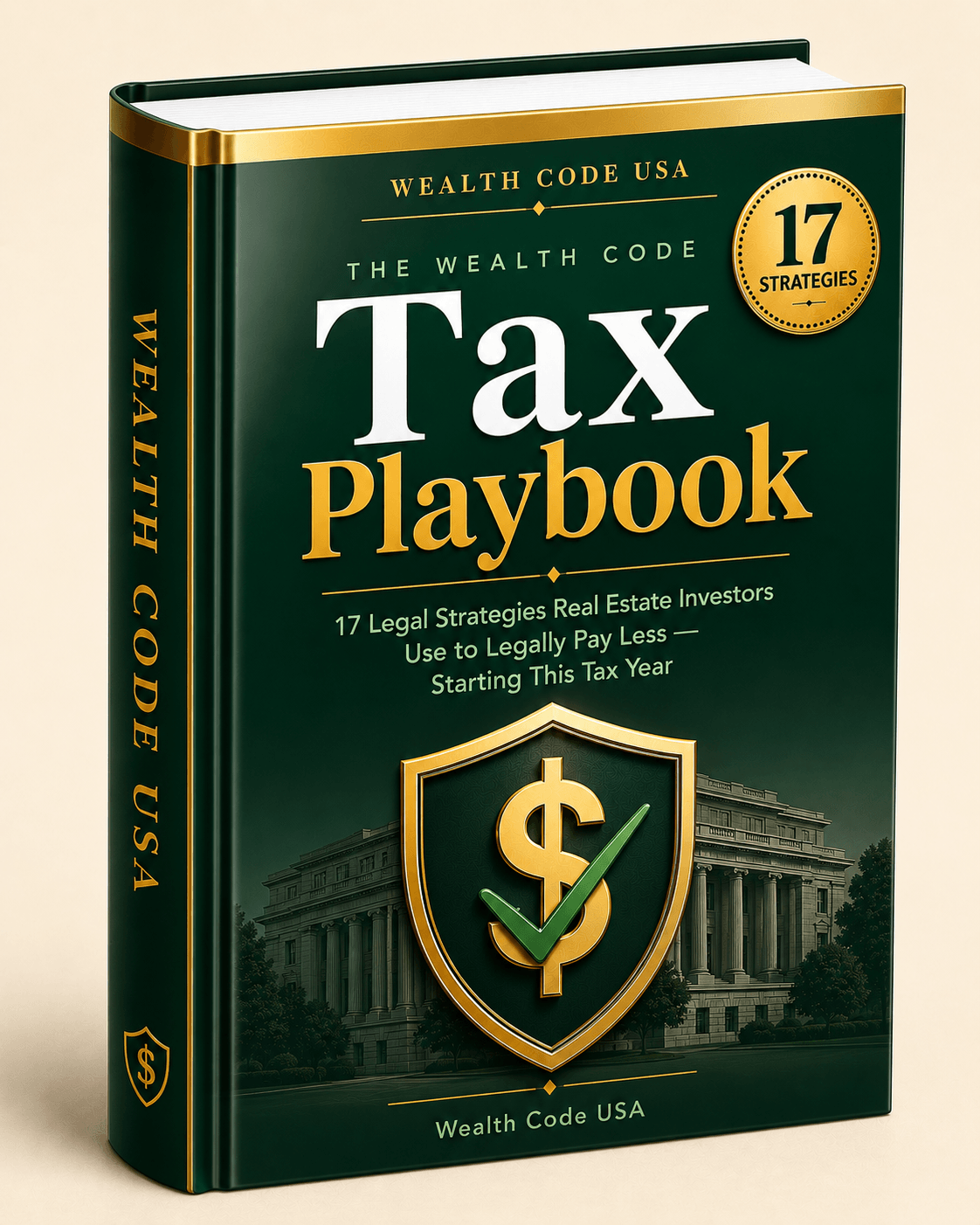
The Wealth Code Tax Playbook is a comprehensive guide to 17 legal tax strategies available to U.S. real estate investors under current federal tax law.
It is not a collection of vague tips. It is a specific, organized playbook — from foundational concepts to advanced structures — that tells you exactly what each strategy is, how it works, what it saves, and how to implement it with your CPA.
The 17 strategies are organized across six chapters:
Chapter 1: How the IRS classifies investors — and the one designation that converts trapped rental losses into unlimited deductions against your W-2 salary
Chapter 2: Depreciation in full detail — including the non-cash deduction, bonus depreciation, cost segregation, and how to recover missed depreciation from prior years in a single filing
Chapter 3: The complete deductible expense list — including the 6 categories most investors miss every year, plus the vehicle, home office, and education deductions that disappear if you don't claim them
Chapter 4: Entity structures — SMLLC, Series LLC, the truth about S-Corps for rental investors, and the living trust strategy that eliminates a lifetime of capital gains at death
Chapter 5: Advanced strategies — the 1031 exchange step by step, Qualified Opportunity Zones, installment sales, and the ultimate exit strategy that can permanently erase decades of deferred gains
Chapter 6: How to work with a real estate CPA — the 7 interview questions, the year-end planning framework, and the 6 red flags in your current return that signal money is being left on the table
SOCIAL PROOF
"I've owned four rentals for seven years and never once claimed depreciation correctly. This book showed me how to file a Form 3115 and recover it all at once. The catch-up deduction created a $31,000 loss on my return. I got a refund check for the first time in six years."
— Robert K., Nashville TN
Four-property portfolio, self-managing landlord
"The chapter on Real Estate Professional status alone was worth ten times the price. My wife qualified this year. We deducted $44,000 in rental losses against my W-2 income. Our tax advisor, before this book, had never even mentioned it was an option."
— James & Carol W., Charlotte NC
W-2 earner + full-time property manager
OBJECTION HANDLING
'My CPA already handles this.'
Does your CPA proactively call you in October to discuss year-end tax strategy? Do they know what a cost segregation study is and when to recommend one? Have they ever discussed Real Estate Professional status with you? If the answer to any of those is no, Chapter 6 shows you exactly what a specialist CPA does differently, and exactly what to ask you.
'Tax law is too complicated — I'll just trust my accountant.'
That trust is costing you money. Not because your accountant is wrong, but because they can only implement strategies you know to ask about. This book makes you an educated client. Educated clients get better advice and pay less tax. Every year.
'I only have one property — does this apply to me?'
Yes — powerfully. Depreciation, the deductible expense list, vehicle deductions, home office, and the entity structure strategies all apply to the first property. The 1031 exchange and cost segregation become relevant as you scale. Starting to apply these strategies now means starting to compound the savings now.
THE OFFER
The Wealth Code Tax Playbook is 40-plus pages of specific, actionable tax strategy for real estate investors — with a master reference card, a year-round deduction tracker, and a 17-question CPA planning guide.
One strategy in this book, implemented correctly, pays for this guide hundreds of times over.
Instant download. 30-day money-back guarantee.
30-DAY GUARANTEE
If this playbook does not give you at least one specific, actionable tax strategy you were not already using,
email us within 30 days for a complete refund. No forms, no questions.

Pay less tax. Legally. Starting now.
Free cheat sheet — 5 strategies most CPAs never mention.
Enter your details for instant access
Your email address is 100% secure, No spam. Unsubscribe anytime.
These are permanent features of the U.S. tax code — available to every property owner in America. Most people just never learn to use them.
The non-cash deduction that can turn a profitable rental into a paper loss — legally — and wipe out thousands in taxable income without you spending a single extra dollar
The three magic words on your tax return that signal you may be leaving $5,000 to $20,000 on the table every single year
How one couple in Atlanta cut their federal tax bill by $10,178 in a single year — without buying a new property or changing their income
The IRS classification that converts your rental losses from 'trapped' to fully deductible against your W-2 salary
The exit strategy that can eliminate decades of capital gains — permanently — with zero illegal activity